A Talk on AI Cost Discipline
Token Economics
Better Results, Fewer Tokens.
02 · THE MOMENT MOST TEAMS NOTICE THE METER
The Bill Nobody Saw Coming
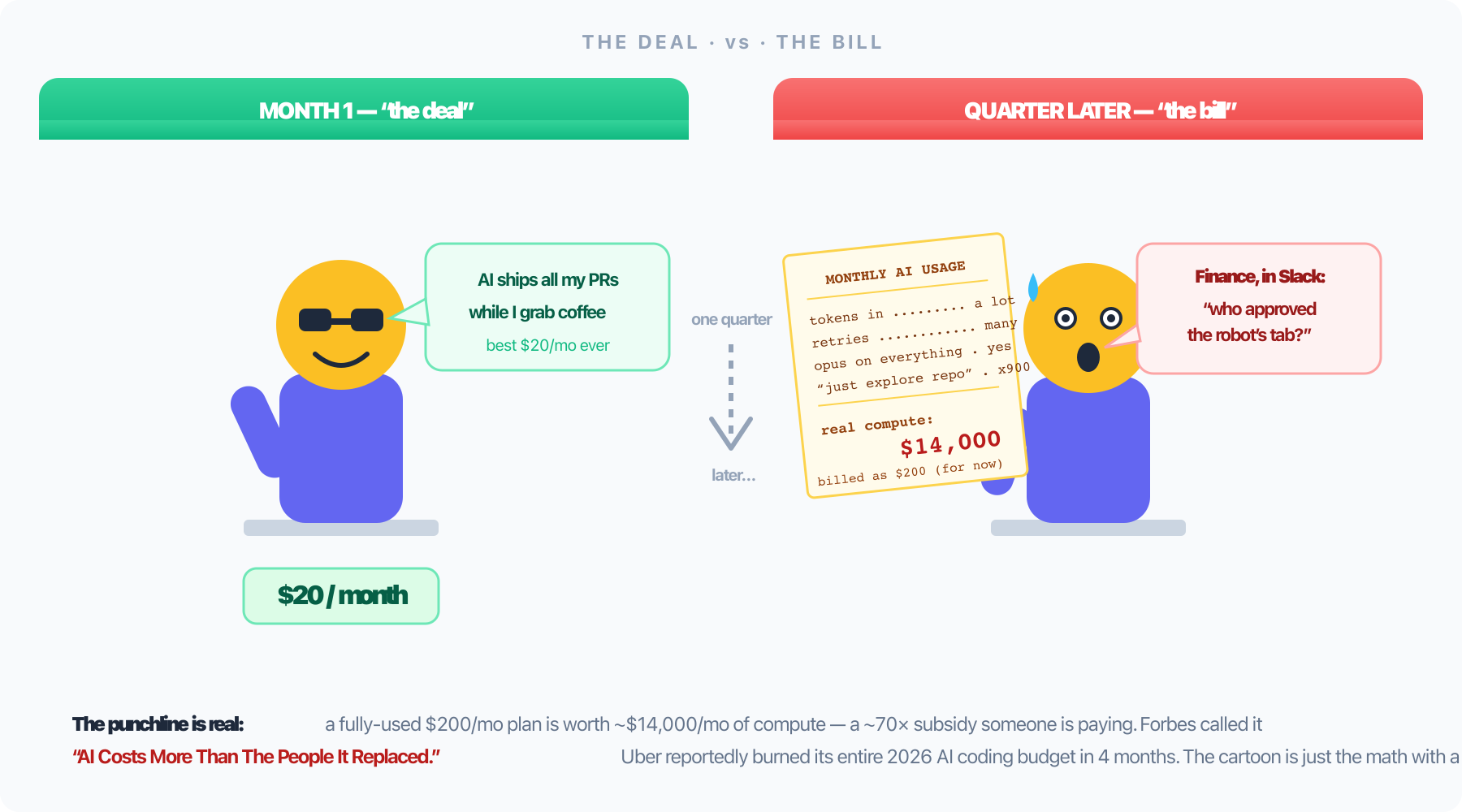
A $200/mo plan ≈ $14,000/mo of real compute — a ~70× subsidy someone is paying.
Community estimates put a heavily-used $200/mo plan at $14,000–35,000/mo of real compute — estimates disagree 2×, but the shape holds: sticker and consumption aren't in the same order of magnitude. Someone is paying the difference.
Forbes · Jul 2026
"AI Costs More Than The People It Replaced."
Uber reportedly burned its whole 2026 AI coding budget in 4 months.
Github Copilot, Reddit
One developer who went from
~$39 subscription to pay-as-you-go got bill of ~$47,000.
03 · THE HIDDEN METER
Every AI Session Has a Meter Running
- We watch output quality. We ignore the token counter.
- Then the monthly bill — or "context limit reached" — shows up.
- Token discipline isn't a personal habit — it's a team cost lever.
The shift
From "is the answer right?" → to "is the answer right, arrived at cheaply, on the first try?"
04 · THE REAL COST EQUATION
Cost ≠ Price Per Token
cost = (price per token) × (tokens per task) × (attempts)
1
Price / token
Advertised. Vendor-controlled.
2
Tokens / task
Your prompt, context, scaffolding.
3
Attempts
Retries, re-asks, re-derivation.
Factor 3 is bigger than it looks
Coding is the #1 use case for AI agents industry-wide, and "fixing errors" alone is ~10% of enterprise API traffic (Anthropic Economic Index). A meaningful slice of the industry's token spend is attempts — paying again for something that didn't work the first time.
05 · PART TWO — THE METHOD
Explore → Plan → Execute → Verify
- Explore — scope it yourself. Never "fix the payment bug"; point it at the component and store. Your codebase knowledge is free; the agent's exploration is not.
- Plan — in read-only mode. Plan Mode blocks write tools at the permission level. Reading a plan takes 2 minutes; reading a wrong 300-line diff takes 20.
- Execute — only after you approve the approach. A plan costs hundreds of tokens; a wrong implementation costs thousands — twice-reviewed.
- Verify — the loop exits on green, not on confidence. The judge is the test runner's output, never the model's opinion of itself.
Ours, as files — skills/: spec · grill · plan · grill · implement · verify · pre-review · fix
plan: "Never skip planning for changes touching two or more files."
implement: "Never batch all changes then verify at the end."
Boris Cherny — the creator of Claude Code — starts most of his own sessions in Plan Mode. The people who built the tool don't trust it unplanned.
06 · THE ADVERSARIAL STEP
Grill: The Agent That Attacks Your Plan
- A skill whose entire job is to be hostile to the work before it — a skeptical staff-engineer review.
- Severity ladder: blocker · critical · major · minor. Verdicts: pass · pass with conditions · needs rework · reject — and reject fires.
- Non-optional:
spec and plan invoke it automatically. A critic you can skip is a critic you skip on the day you needed it.
Why a separate invocation
Asking the same session "is this plan good?" gets a yes — same model, same blind spots, looking at its own reasoning. That's not a review. That's a mirror.
The cheapest attempt-killer we've built: a rejected plan costs 5 minutes; a rejected implementation costs an afternoon and two reviews.
07 · THE MOST STEALABLE HABIT
The Cheapest Reviewer Is Your Own Diff
Feature works? Don't raise the PR yet — run the agent over your own diff first.
Review git diff main against our checklist.
- Private — the embarrassing stuff gets caught before a colleague ever sees it.
- Cheap — input is a few thousand tokens of diff; and it kills most of the review-bounce cycle (attempts, at PR granularity) before it starts.
- Consistent — the checklist is a skill (
pre-review) backed by an 800-line coding-standards doc the agent must read: versioned, PR-reviewed, executed identically by junior and senior. Review culture, under version control.
08 · TESTS
Tests: The Honesty Rules
Rule 1
Never let the agent write the tests and the implementation in the same session. An agent grading its own homework writes tests that certify its own bugs. Tests come first — from the spec, or a fresh session.
Rule 2
The loop exits on green, not on confidence — and feed the model failures only: the three tests that broke, not the four hundred that passed.
Bonus for every 15-year-old codebase: characterization tests on legacy code — pin down current behavior before touching it. Used to be a week nobody would approve; now it's an afternoon.
09 · THE CHEAP-TOKEN TRAP
Cheaper Per Token ≠ Cheaper Per Task
Per-token price says
Gemini 3.5 Flash $1.50/M vs 3.1 Pro ~$2.00/M — Flash looks like the win.
Per-task cost says
Flash: $1,552 vs Pro: ~$887 on the same benchmark — 75% more expensive. Cheap models burn more tokens per task.
And it's the whole field, not one vendor: $2.73 per task at the top (Claude Fable 5) down to cents for open-weight models — a spread of roughly two orders of magnitude, same benchmark, same month.
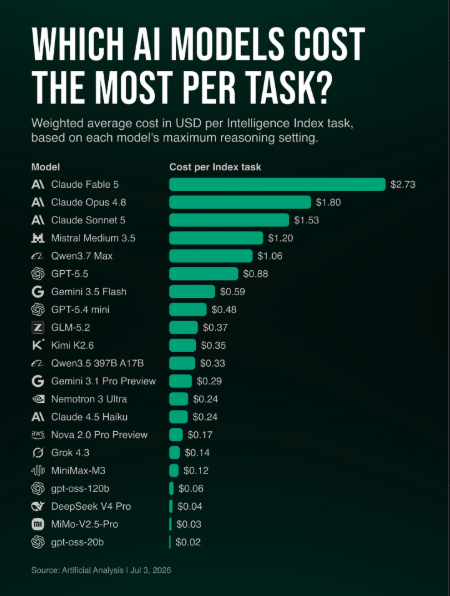
Artificial Analysis, cost-per-task, Jul 3 2026.
The unit that matters is the completed task — in either direction: don't buy a Ferrari for the grocery run, don't buy per-token "savings" that triple the attempts.
10 · MODEL TIERING
Pay for Reasoning Only When Needed — Every Vendor Has a Ladder
| Model | Input | Output | Use for |
|---|
| Haiku 4.5 | $1/M | $5/M | Lookups, file discovery |
| Sonnet 5 | $2→3/M | $10→15/M | Daily implementation |
| Opus 4.8 | $5/M | $25/M | Architecture, hard debugging |
| Fable 5 | $10/M | $50/M | Above Opus — hardest reasoning |
| GPT-5.6 Luna/Terra/Sol | $1→2.5→5/M | $6→15→30/M | OpenAI's cheap→default→flagship |
| GLM-4.6 / MiniMax M2 / Kimi K2.6 open-weight | $0.26–0.95/M | $1–4/M | Cheap tier, self-hostable |
Haiku 4.5 — the workhorse
~$0.13 spent per SWE-bench Pro point — cheapest correct-fix ratio of any current model.
Our rule · ~/.claude/rules/model-routing.md
Default to the mid tier. Escalate to flagship only when reasoning depth justifies 5–25× the cost.
11 · BEYOND ONE VENDOR
Same Arithmetic, Different Tools
| Tool | Access | The tradeoff |
|---|
| Claude Code / Codex CLI | One vendor | Predictable, but capped on heavy days |
| OpenCode open-source | 75+ providers, switch mid-session | One UI, any vendor's pricing underneath |
| OpenRouter | 300+ models, one key | Cross-vendor arbitrage; proxy hop for caching |
| Local (Ollama / LM Studio) | Whatever fits your hardware | $0/token, but not free — see the next slide |
Pick the tool for the constraint that binds: data residency → local · flexibility → OpenRouter/OpenCode · out-of-the-box quality → Claude Code/Codex.
12 · DEVICE COST
The Bill Isn't Only Tokens
- Every parallel agent session is a concurrent process on the same CPU, RAM, and battery — a throttled laptop produces worse agent output long before the API bill is the bottleneck. Our fix: a guard that skips heavy hooks when load > 50% of cores or free memory < 2GB.
- Local models shift the cost, not remove it: $0/token trades for GPU/RAM hardware, electricity, and slower throughput — real money, just billed differently.
13 · FEED LESS, NOT MORE
Bigger Window ≠ Better Recall
Accuracy drops as token count climbs — even well inside the limit. Context rot is real; the fix is a smaller haystack, not a bigger window.
- On-demand retrieval: our knowledge graph (
graphify + code-review-graph) indexes 1,000+ files for 0 LLM tokens (Tree-sitter → SQLite); skipping it burns ~20,000 tokens re-orienting every session.
- Enforced, not requested: a hook intercepts every grep the agent tries — if the graph can answer, the grep is blocked, and the refusal message prices it: graph ≈ 100 tokens vs. ≈ 1,500 for the search sweep — a rule in a hook is a constraint, not a request.
- Subagents with clean, disposable context — the transcript gets thrown away, only the conclusion survives.
- Compact deliberately: long session? Summarize and start fresh instead of replaying the whole transcript — same discount as caching, applied to session length.
- Prompt caching — big enough to get its own slide →
14 · CACHING — THE 90% LEVER
The Single Biggest Zero-Quality-Loss Lever
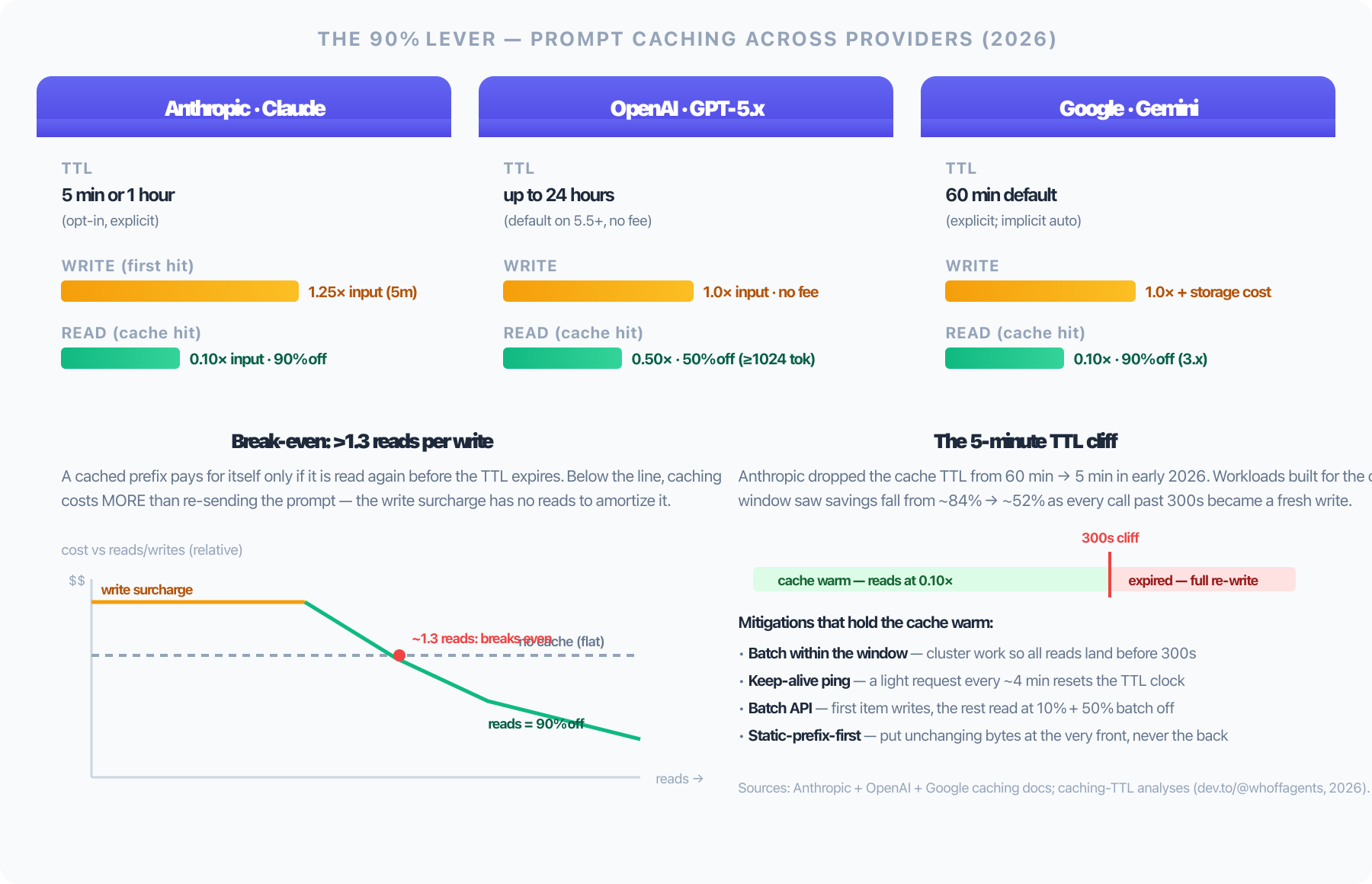
The provider already computed your static prefix last call. Keep it warm → reuse it at a fraction. Output is byte-identical; only the bill and latency change. ~90% off the cached input is the number all three majors converge on.
| Provider | TTL | Write | Read (Cache hit) |
|---|
| Claude | 5 min / 1 hr | 1.25× (2.0× / 1hr) | 0.10× · 90% off |
| GPT-5.x | up to 24 h | 1.0×, no fee | 0.50× · 50% off |
| Gemini 3.x | 60 min | 1.0× + storage | 0.10× · 90% off |
15 · MEMORY COMPOUNDS
Reuse Beats Re-Derivation
One real session — this repo's own memory index.
23,909
Tokens — reading 50 indexed observations
485,629
Tokens — original work that produced them
95%
Fewer tokens — same starting knowledge
Same idea pointed backward
Mine your own chat logs and PR review comments for recurring corrections — same nit on three PRs is a pattern, not three nits. Encode it once in CLAUDE.md/rules; the model stops repeating the mistake, and "number of attempts" from Slide 4 stops multiplying.
The infra that makes it systematic
Skills (Claude Code, OpenCode's plugin system) package a repeatable workflow instead of re-explaining it every time. Memory plugins persist facts and decisions across sessions, so a new conversation starts with what a prior one learned instead of from zero.
Capture once. Read forever. Don't re-derive — forward or backward.
16 · MAKE THE METER VISIBLE
You Can't Cut What You Can't See
Every agent writes local logs, so tracking is always possible. Pick the tracker that reads your agent's logs.
| Agent | Native | Logs | Tracker (with the con) |
|---|
| Claude Code | /cost, /context, SDK | local files | ccusage ✅ 5-hr-block view · ❌ Claude-centric |
| Codex CLI | in-session totals (light) | ~/.codex/sessions/*.jsonl | tokscale ✅ cross-agent · ❌ newer |
| OpenCode | no tracking command | SQLite / JSON | opencode-stats ✅ 365-day · ❌ OpenCode-only |
| All / enterprise | — | — | Dynatrace / Portkey ✅ governance · ❌ overhead |
The habit
Glance at usage before escalating to the flagship model · review the weekly report before fanning out 20 subagents · watch the 5-hour block on subscription tiers.
Every cut on the next slide came from this — Headroom cut once device load was measured; the idle graph MCP pruned once its context tax was measured.
17 · MY TOOLKIT — WHAT I RUN, WHAT I CUT
Marketing Shows the Pros. These Are the Cuts.
Three layers stack: output (write less) · input (read less) · routing (cheaper provider).
| Tool | Layer | Verdict — with the con |
|---|
| Ponytail | output / code | ✅ run — YAGNI ladder, shortest diff (6–20% lines, 23–53% cost) |
| caveman | output / prose | ✅ run — ~75% fewer tokens; overlaps Ponytail by design |
| RTK (rtk-ai/rtk) | input / shell | ✅ run — Rust, <10ms, 60–90% off Bash output; Read/Grep bypass |
| Headroom | input / files | ❌ cut — 60–95% off, byte-perfect, but ~600MB ML daemon = device-drag |
| OmniRoute | routing | ❌ cut — 237-provider gateway → quality drift + ToS-ban pattern |
| graphify / CRG | index | ⚠️ project-local only — behind resource guards; cut as global daemon |
| branchdiff mine | review | ✅ run — pipes just the diff, nth-time awareness skips re-raised nits |
The rule that decided most of it
Ban risk lives on the wire — a tool only risks a ban if it sits between you and the provider and mutates the payload. Rule-injection (Ponytail) = zero. Proxies (Headroom, OmniRoute) = real. That's why my stack has zero proxies.
18 · BEYOND THE BILL
Two Reasons This Isn't Only About Money
⚡ Energy & water
AI data centers alone: 945 TWh by 2030 — nearly triple Pakistan + Bangladesh + Nigeria's combined electricity use. Every wasted token is a real watt.
📉 The subsidy is ending
OpenAI reportedly spends ~$2 per $1 earned on inference — nobody sustains that as a strategy, only a land grab. Anthropic and GitHub Copilot already moved to usage-based billing in 2026; prices rise 30–50% within 12–24 months.
"Won't tokens just get cheaper?" Cheaper shrinks factor 1, not factor 3 — a wrong implementation still costs two reviews. And cheaper never meant less: Jevons paradox.
19 · THE SUBSIDY ENDING, VISUALIZED
How Did We Get So Poor
Before AI, the funnel only grew: idea → execute → usage, small group to more at every stage. After AI, that funnel flips — everyone ideates, execution and real usage shrink.

The subsidy ending, visualized.
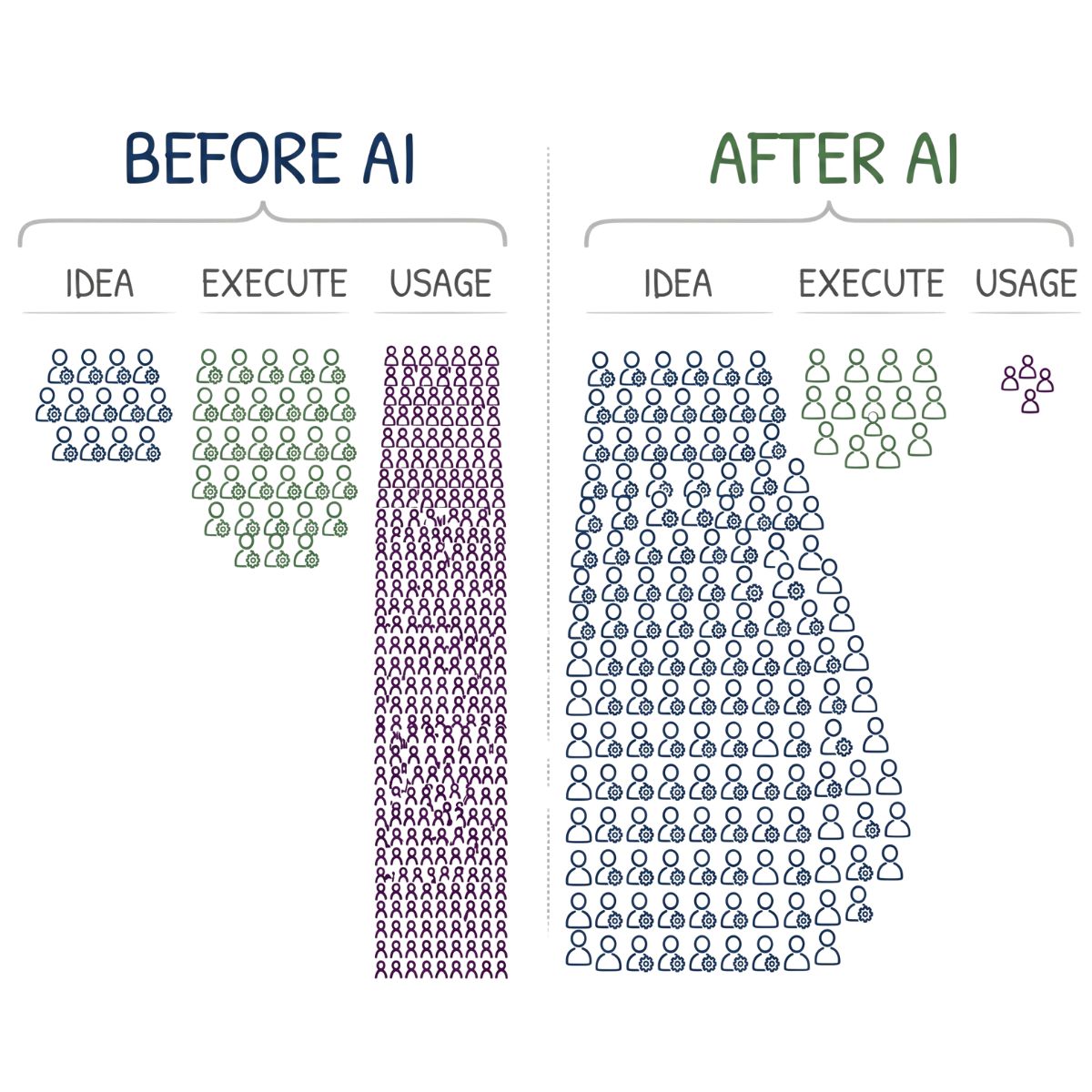
Idea → execute → usage, before and after.
20 · AI OUTPUT VS. OUTCOME AND IMPACT
Output ≠ Outcome ≠ Impact
AI's headline effect isn't better decisions — it's more Output (code, summaries, predictions, instantly). But Output, Outcome, and Impact are three different things, and AI only ever hands you the first one:
- Output — the immediate, direct result the model generates: a code snippet, a summarized document, a predictive score.
- Outcome — the observable shift in behavior or process caused by that output: a bug actually stops recurring, a report actually gets acted on.
- Impact — the ultimate business or strategic value that shift produces: lower support cost, higher revenue, a team that ships without burning out.
Ten AI-drafted PRs is Output, verifiable in seconds. Whether they cut defect rates is Outcome. Whether that's a calmer on-call rotation six months later is Impact. More Output doesn't automatically buy more Outcome, and more Outcome doesn't automatically buy more Impact — that gap is exactly where judgment lives.
21 · APPLY THIS WEEK
Checklist
- Plan before you generate — a plan costs hundreds of tokens; a wrong implementation costs thousands, twice-reviewed
- Let something adversarial attack the plan before code exists
- Review your own diff before the PR
- Never let an agent be the sole reviewer of agent-written code; never let it write the tests and the implementation in the same session
- Hard rules in hooks, not prompts — a prompt is a request, a hook is a constraint
- Route by task: cheap tier (Haiku, GLM, MiniMax, Kimi) → mid tier (default) → flagship
- Match the tool to the constraint that binds — local, OpenRouter/OpenCode, or Claude Code/Codex
CLAUDE.md under ~200 lines; globbed rules for the rest- Command hooks over prompt hooks for deterministic checks
- Index once (Tree-sitter), query on demand; reuse memory instead of re-deriving it
- Long session? Summarize and start fresh instead of replaying the whole transcript
- Cache structured for the window — static prefix front, dynamic state back, batch inside TTL, stagger your first parallel call
- Mine chat logs and PR review comments for recurring corrections; encode each one once
- Guard background jobs (CPU/memory + dedupe) before running multiple worktrees
- Smallest correct diff, always — it's a discount on every future session, every watt, every dollar