Domain-Driven Design — Deep Dive
Aggregates, Events, Repositories, Ports & Adapters, and Context Maps in a real system.
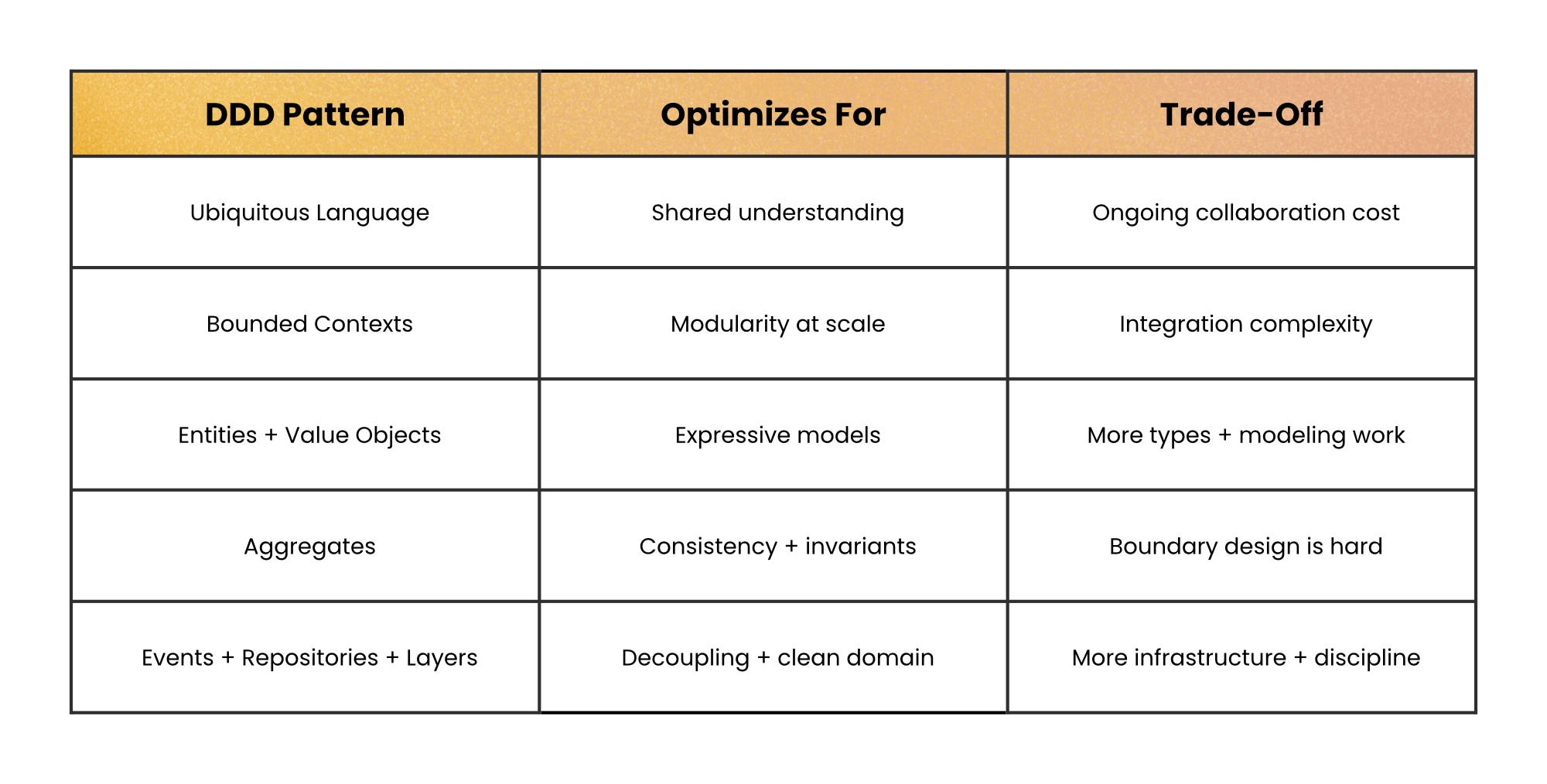
Five Patterns, One Goal: Protect the Model as It Scales
| Pattern | Optimizes for | Trade-off |
|---|---|---|
| Ubiquitous Language | Shared understanding | Ongoing collaboration cost |
| Bounded Contexts | Modularity at scale | Integration complexity |
| Entities + Value Objects | Expressive models | More types + modeling work |
| Aggregates ← today | Consistency + invariants | Boundary design is hard |
| Events + Repositories ← today | Decoupling + clean domain | More infrastructure + discipline |
This deck traces back to a specific source: Eric Evans' 2003 book Domain-Driven Design — Aggregate, Entity, Value Object, Domain Event, and Repository are his tactical patterns by name.
When Nothing Owns the Rules, Everything Can Break Them
Order lives as a plain data bag. Two different parts of the codebase mutate it directly.
// order.ts — just a data shape, no rules attached
interface Order { id: string; status: "draft" | "placed"; lineItems: LineItem[]; }

// checkout-controller.ts
function addPromoItem(order: Order, item: LineItem) {
  order.lineItems.push(item);   // works even if the order was already placed
}

// admin-panel.ts — written by a different team, six months later
function forceAddItem(order: Order, item: LineItem) {
  order.lineItems.push(item);   // same mistake, independently
}
One Door In — Aggregates & the Aggregate Root
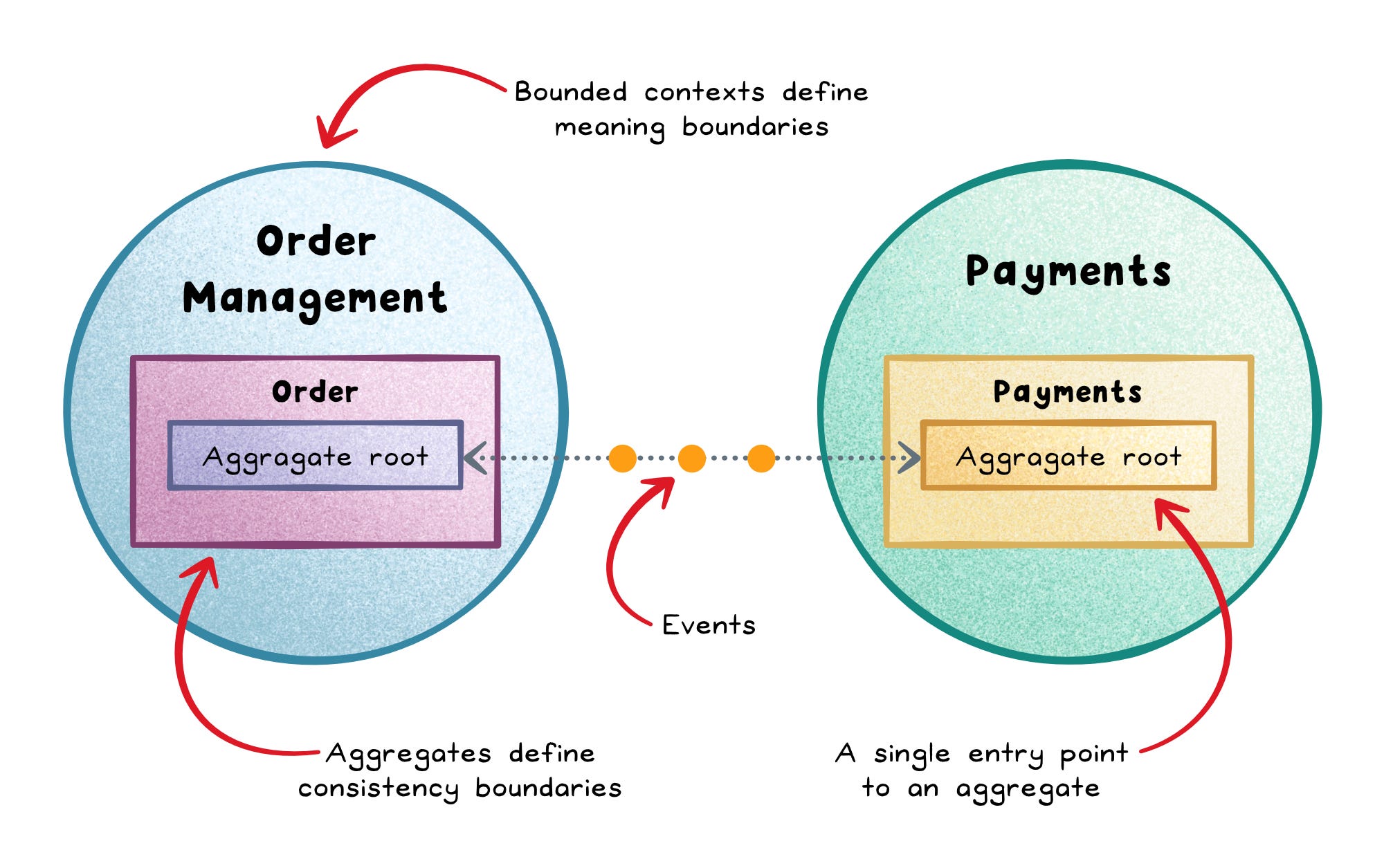
An aggregate is a cluster of domain objects treated as a single consistency boundary, controlled by one aggregate root. Outside code talks only to the root.
class Order {                    // Aggregate Root
  private lineItems: LineItem[] = [];
  private status = "draft";

  addLineItem(item: LineItem) {
    if (this.status !== "draft")
      throw new Error("Cannot modify a placed order");
    this.lineItems.push(item);
  }

  place(): OrderPlaced {
    if (!this.lineItems.length)
      throw new Error("Cannot place an empty order");
    this.status = "placed";
    return new OrderPlaced(this.id, this.lineItems);
  }
}
Both controllers now call order.addLineItem() — the "already shipped" bug is no longer representable in code.
A Change in One Service Breaks Three Others
OrderService.place() looks harmless — until you see everything it directly calls.
class OrderService {
  async place(order: Order) {
    const event = order.place();
    await inventoryService.reserveStock(event.lineItems);  // direct call
    await emailService.sendConfirmation(event.orderId);    // direct call
    await analyticsService.track("order_placed", event);  // direct call
    await loyaltyService.addPoints(event.orderId);         // added last sprint
  }
}
OrderService again. When reserveStock was renamed during a refactor, OrderService broke — even though the change had nothing to do with placing an order.
Let Other Contexts React — Without Reaching In
A domain event captures something meaningful that already happened. Published outward, it becomes an integration event other contexts subscribe to independently.
class OrderPlaced {
  constructor(public readonly orderId: string, public readonly lineItems: LineItem[]) {}
}

class OrderService {
  async place(order: Order) {
    const event = order.place();
    eventBus.publish(event);   // ONE line — no longer knows who's listening
  }
}

eventBus.on(OrderPlaced, e => inventoryService.reserveStock(e.lineItems));
eventBus.on(OrderPlaced, e => emailService.sendConfirmation(e.orderId));
eventBus.on(OrderPlaced, e => loyaltyService.addPoints(e.orderId));
Growth path, no domain code changes: in-process EventEmitter for an MVP → Redis pub/sub once split into services → Kafka once events need replay/audit at scale. Only the adapter under eventBus changes.
When the Database Leaks Into the Domain
async function place(orderId: string) {
  const rows = await db.query(`SELECT * FROM orders WHERE id = $1`, [orderId]);
  const order = rows[0];
  if (order.status !== "draft") throw new Error("Cannot modify a placed order");
  await db.query(`UPDATE orders SET status = 'placed' WHERE id = $1`, [orderId]);
  // business rule and SQL string, tangled in the same function
}
orders. Nobody could test "can't place an empty order" without a real database.
Keep the Database Out of the Domain
A repository is a domain-facing interface for loading and saving aggregates — it hides persistence behind domain vocabulary.
interface OrderRepository {
  findById(id: string): Promise<Order | null>;
  save(order: Order): Promise<void>;
}

async function place(orderId: string, repo: OrderRepository) {
  const order = await repo.findById(orderId);
  const event = order.place();     // pure business logic, from Slide 4
  await repo.save(order);
  eventBus.publish(event);
}
Swap Postgres for DynamoDB — only the concrete PostgresOrderRepository changes. place() is now unit-testable with an in-memory fake, zero database.
How a Context Is Layered — Everything Points Inward
OrderRepository is a small example of a bigger idea: Ports & Adapters. It's a port Domain/Application owns; PostgresOrderRepository is the adapter plugging into it from Infrastructure.
| Layer | What lives here | From this deck |
|---|---|---|
| Domain (zero deps) | Aggregates, Entities, VOs, Events | Order, OrderPlaced |
| Application | Orchestrates the domain | place(orderId, repo) |
| Infrastructure | Implements the ports | PostgresOrderRepository, eventBus |
| Interfaces | Calls in from outside | public/admin/service routes (Slide 14) |
Order and OrderPlaced have never heard of Postgres, Redis, or Express. Infrastructure and Interfaces depend on Domain — never the reverse.
Ownership Matters More Than Physical Separation
Does Order Management need a physically separate database from Inventory? The rule isn't physical separation — a bounded context must be the only thing that ever writes to (and directly reads) its own data.
| Architecture | What "database per context" looks like |
|---|---|
| Microservices | Usually a genuinely separate physical database per context |
| Modular monolith | One physical instance is fine — separate schemas, zero foreign keys crossing the boundary |
When a Third Party's Model Leaks Into Yours
// scattered across 6 files, wherever a webhook is handled
function handleWebhook(payload: any) {
  const orderId = payload.order_ref;        // legacy snake_case
  const amount  = payload.amt_cents / 100;  // legacy field, cents not dollars
  const currency = payload.cur;             // legacy abbreviation
}
amt_cents to amount_minor_units in a v2 API. Six files broke, six different ways.
A Translator at Every Boundary — Not Just the Third-Party Edge
// payment-gateway-acl.ts — the ONLY file that knows the vendor's field names
function translateGatewayWebhook(payload: LegacyGatewayPayload): PaymentCompleted {
  return new PaymentCompleted(payload.order_ref, Money.fromCents(payload.amt_cents, payload.cur));
}

// order-management/ProductRef.ts — Order Mgmt's OWN view of Inventory's Product,
// even though Inventory is a fully-trusted in-house team
interface ProductRef { sku: string; available: boolean; }
The rule of thumb reverses what beginners assume: a translated reference is the default at every boundary, in-house or not. Shared Kernel — jointly co-owning a small slice like Money — is the deliberate exception.
Two Questions: a Business One, a Coding One
Business — team patterns:
- Partnership — Order Mgmt & Inventory, both in-house, evolve together via a standing contract review.
- Customer/Supplier — Inventory (upstream) ships on its schedule; Order Mgmt (downstream) formally requests changes.
- Conformist — Payments is a vendor; zero negotiating power, isolated behind the ACL.
Coding — explicit contracts only:
- Synchronous — versioned REST/gRPC, "ask and wait now."
- Async events — a message bus, "tell me when it happens."
- Published Language — a jointly-versioned schema (OpenAPI/Protobuf) — the same doc the Partnership meeting reviews.
Public API, Admin API, Service-to-Service — Same Aggregate
Revisit Slide 3: the bug wasn't that the admin panel was "different code" — it had its own separate door into lineItems instead of the same aggregate as everything else.
// public-api/orders-controller.ts
app.post("/orders/:id/items", (req, res) => order.addLineItem(req.body.item));

// admin-api/orders-controller.ts — a DIFFERENT route, SAME aggregate method
app.post("/admin/orders/:id/items", requireSupportRole, (req, res) =>
  order.addLineItem(req.body.item)   // the invariant fires here too — no bypass
);
Public, Admin, and Service-to-service are three Interfaces-ring adapters (Slide 9) — all funneling into the identical Order aggregate.
One Flow, Every Pattern in Its Place
 Public API      Admin API      Service-to-service
 (customer)      (support)        (other contexts)
     │               │                   │
     └───────────────┼───────────────────┘
                     ▼
           ┌─────────────────┐   Order.place()         ┌──────────────────┐
           │ Order (Aggregate │──────────────────────▶ │ OrderPlaced event │
           │      Root)       │  enforces invariants   └──────────────────┘
           └─────────────────┘                                   │
                   │  OrderRepository.save()                      │  published on event bus
                   ▼                                               ▼
           ┌─────────────────┐                          ┌───────────────────┐
           │   Persistence    │                          │ Inventory context │
           │ (own schema/DB)  │                          │ reserves stock     │
           └─────────────────┘                          │ (a Go service)     │
                                                          └───────────────────┘
                                                                     │
                                                                     ▼
                                                           ┌───────────────────┐
                                                           │ Payments context   │
                                                           │ (via ACL, external │
                                                           │  gateway webhook)   │
                                                           └───────────────────┘
Ubiquitous Language named every box the way Northwind would. Bounded Contexts kept "Product" from fighting over meaning. Aggregates + Ports & Adapters stopped the admin-panel bug across all three doors. Events decoupled Inventory — on a different stack — from Order's internals. Repositories + schema boundaries kept SQL and cross-context joins out. The ACL kept a vendor's v2 migration to one file.
Take It Back to Your Codebase
- Find your biggest "god object." Identify its aggregate root and the invariants it should enforce alone.
- Name one domain event your system already has implicitly, and make it explicit.
- Check whether your domain layer imports anything database- or framework-specific — a missing repository, and a Ports & Adapters violation.
- Search for a SQL join spanning two bounded contexts' tables — a database boundary already crossed.
- Check whether any context imports another in-house context's model directly instead of a translated reference — a missing ACL, not just a third-party concern.